



Deciding when to raise a psychiatric referral is one of the harder judgment calls in outpatient practice. Refer too quickly and you risk medicalizing a problem the client could work through. Wait too long and your client spends months white-knuckling symptoms that a thoughtful medication evaluation might have eased. This post offers a practical framework for spotting the signals, raising the conversation, and choosing a psychiatric partner who will support your work rather than complicate it.
Signals That Stalled Progress May Have a Biological Component
No single sign is decisive, but when several of these cluster together, a psychiatric evaluation is worth considering:
- Skills that won’t deploy. Your client can describe their coping strategies perfectly in session but cannot access them in the moment. When baseline anxiety is high enough, the physiological alarm overrides everything you have built together. Medication can lower that floor so the skills finally have room to work.
- Attention symptoms interfering with the therapy itself. The client loses the thread mid-session, forgets homework not from avoidance but from genuine working-memory failure, or has a lifelong pattern of starting strong and trailing off — in jobs, relationships, and now in treatment. With roughly 4.4% of adults meeting criteria for ADHD and most cases going untreated,³ ADHD quietly undermines therapy more often than it gets credit for.
- Vegetative symptoms. Persistent sleep disruption, appetite change, or a fatigue that rest does not touch. These respond unevenly to psychological intervention alone.
- A true plateau despite a strong alliance. Good rapport, good adherence, an approach that fits the presentation — and yet the symptom severity has not budged in months. That pattern deserves a second set of eyes.
- Family history. A first-degree relative who responded well to medication raises the likelihood your client will too.
Raising It Without Undermining the Work
Many clients hear “maybe you should see a psychiatrist” as “therapy failed” or, worse, “you failed.” The framing that works best positions medication as something that serves the therapy, not something that replaces it:
Two points tend to land well. First, an evaluation is information, not a commitment — the client is agreeing to a conversation with a physician, nothing more. Second, the evidence supports the team approach. In the landmark NIMH MTA study of childhood ADHD, 68% of children receiving combined treatment were rated as successfully treated at the end of the 14-month trial, versus 34% with behavioral treatment alone.⁴ In anxiety disorders, the evidence varies by diagnosis, but when physiological arousal is high enough to block exposure-based work, reducing it pharmacologically is often what lets the therapy succeed. A referral is not a handoff. You remain the anchor of their care.
What to Expect from a Good Psychiatric Partner
Every therapist in Pennsylvania has lived the frustrating version of this story: you make the referral, and your client joins a months-long queue. In a 2023 mystery-shopper study that called 948 psychiatrists posing as new patients, fewer than one in five were available to see a new patient, and the median wait for an in-person appointment was 67 days¹ — more than double the 26-day average for new-patient appointments across other medical specialties.² Momentum dies in that gap, and some clients never go at all.
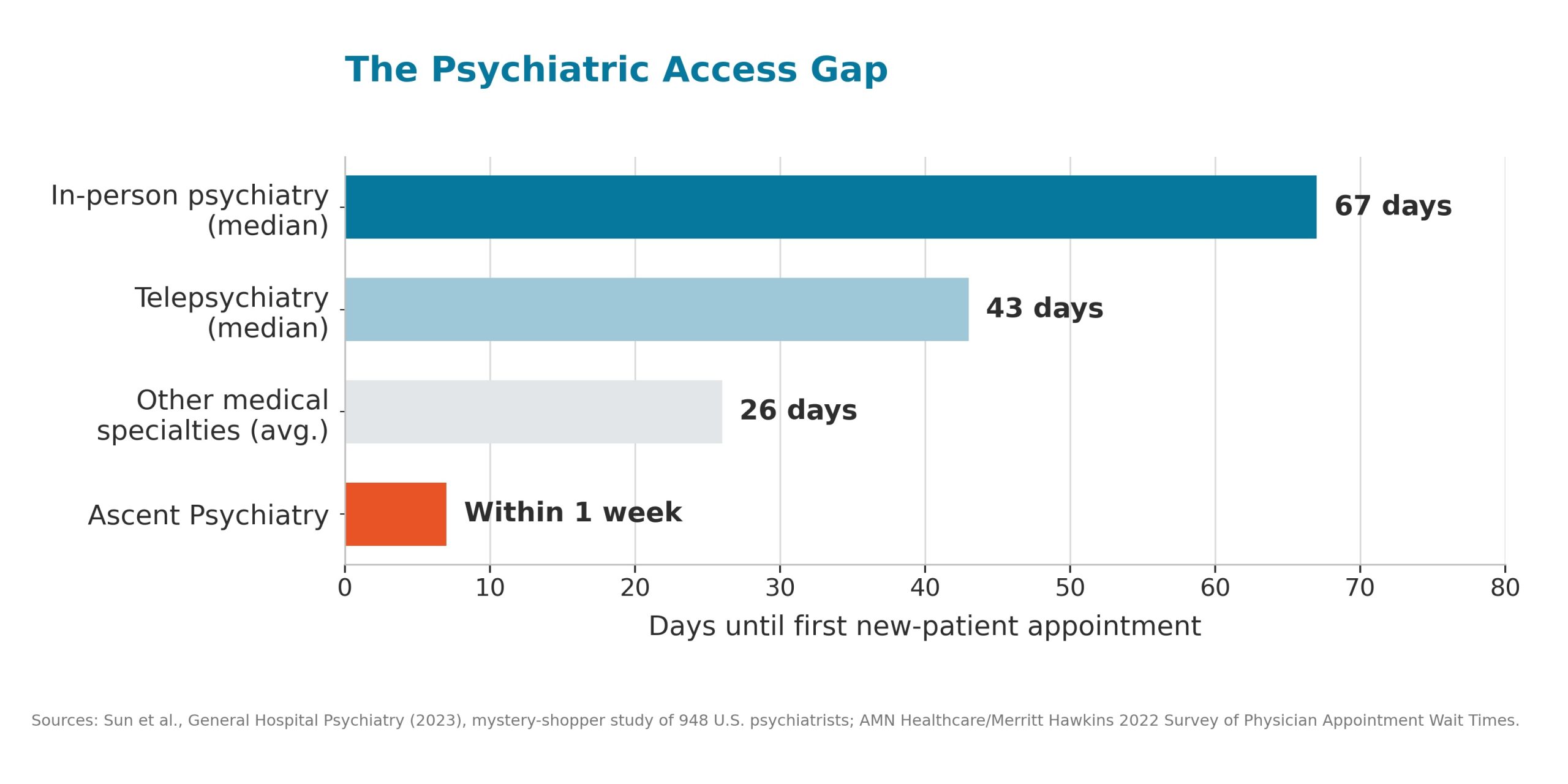
If that has made you hesitant to refer at all, the bar you should hold a psychiatric practice to is simple:
- Fast access. A referral made at the moment of readiness should be seen within days, not months. Readiness is perishable.
- Real appointments. Long enough to take a genuine history — not a fifteen-minute medication check with a stranger.
- Communication back to you. With the client’s consent, you should know the patient was seen, what the plan is, and how to coordinate. You should never have to chase a psychiatrist for an update.
- Respect for the therapy. A psychiatrist who tells your client they can stop therapy because the medication is working does not understand the evidence — or your role.
How Ascent Works with Referring Therapists
Ascent Psychiatry was built around exactly these frustrations. When you refer a client to us, they speak with a dedicated Care Navigator who handles every piece of logistics — scheduling, paperwork, testing, follow-up — and their first appointment happens within a week. Appointments are longer by design, because people are much more than a diagnosis, and a treatment plan should be built around a person’s life, values, and priorities.
Dr. Modan brings more than twenty years of clinical experience, with fellowship training in child and adolescent psychiatry at Dartmouth and addiction psychiatry training at NYU. We treat children, adolescents, and adults across Pennsylvania via telehealth, with particular depth in ADHD and anxiety — the two presentations most likely to be sitting, partially hidden, in a therapy caseload.
And we close the loop. With your client’s consent, you will hear from us after the first visit: they were seen, here is the plan, here is how to reach us. Your client stays your client. We are simply the medication arm of a team you are already leading.
Referring Is Simple
Have your client call (215) 876-5015 or email [email protected] and mention your name. Their Care Navigator takes it from there. If you would like to talk with Dr. Modan first — about a specific client or just to know who you are referring to — we are glad to set up a brief introduction call.