



Adult ADHD or Anxiety? Untangling Overlapping Symptoms in Your Clients

A client presents with restlessness, poor concentration, disrupted sleep, and a mind that will not stay where they put it. That cluster fits generalized anxiety. It also fits adult ADHD. And — more often than either textbook would suggest — it fits both at once. Getting this differential right matters, because the treatments diverge and the wrong frame can cost a client years.
Picture of AUTHOR

AUTHOR

Dr. Yusuf Modan

Why the Two Get Tangled

Both conditions produce inattention, but by different routes. Anxiety hijacks attention: the client cannot concentrate because their cognitive bandwidth is consumed by worry, threat-scanning, and rehearsal. ADHD fails to deploy attention: the client cannot concentrate because the regulation system itself is inconsistent — including when they are calm, including for things they care about. The downstream behavior looks identical in a fifty-minute session. The history rarely does.
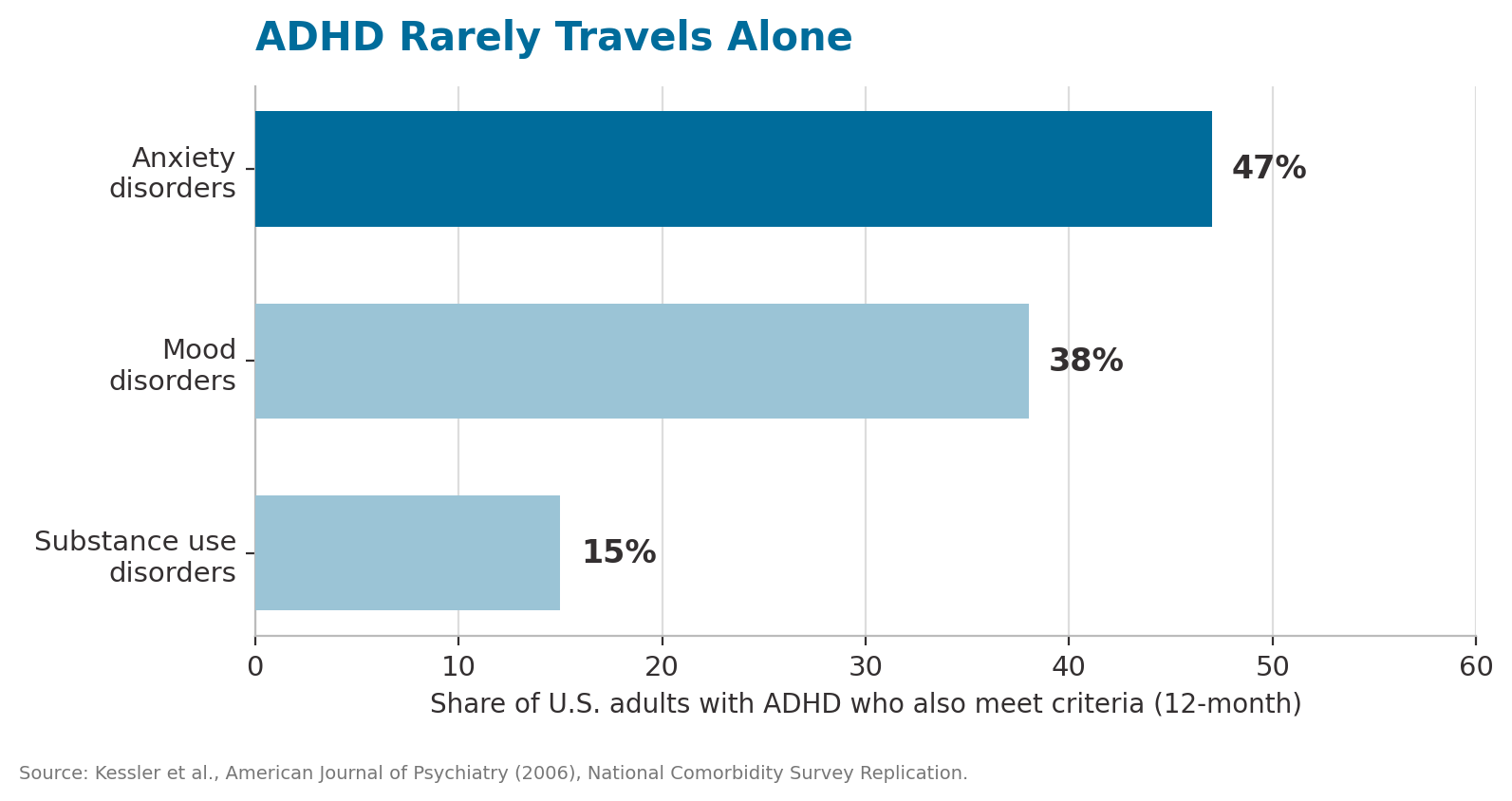
And frequently the question is not either/or. In the National Comorbidity Survey Replication, nearly half of adults with ADHD also met criteria for an anxiety disorder.¹ Some of that anxiety is independent. Some of it is secondary — the accumulated dread of a life spent missing deadlines, losing keys, and disappointing people for reasons the client could never quite name. Treat only the anxiety in those clients and you are bailing water without patching the hull.

Questions That Sharpen the Differential

  • Timeline. “Tell me about fourth grade.” ADHD is neurodevelopmental; the trail runs back to childhood, even when it was never named. Anxiety more often has an onset, a context, a before-and-after.
  • Attention in calm waters. “When you’re relaxed and reading something you chose — what happens?” The anxious client can often sink in; the ADHD client drifts even on vacation.
  • The flavor of restlessness. Anxious restlessness is driven by dread and quiets when the threat resolves. ADHD restlessness is constitutional — it is there on good days too.
  • What worry is doing. Anxious clients worry ahead of events; ADHD clients are more often ambushed by them. “I knew it was due and couldn’t make myself start” is a different sentence from “I couldn’t stop thinking about it going wrong.”
  • Response to structure. External scaffolding, like deadlines, body-doubling, accountability, often transforms ADHD performance. It soothes anxiety much less.

Raising the Possibility With a Client

“Some of what we’ve been calling anxiety might have a second layer underneath it. The way you describe your attention — even on calm days, even for things you love — makes me want a proper evaluation, because if there’s an attention piece, treating it could make everything else we’re doing easier.”

— Sample framing when ADHD may be hiding under an anxiety presentation

Self-report screeners and a strong clinical hunch are a starting point, not an answer. A thorough psychiatric evaluation takes the developmental history, rules out mimics — thyroid disease, sleep disorders, substance effects, trauma — and sequences treatment when both conditions are present. That sequencing is where expertise earns its keep: stimulants started in an untreated panic disorder can pour fuel on it, while SSRIs alone in an unrecognized ADHD picture treat half the problem and get half the credit.

This differential is the daily work of Dr. Modan’s practice. With fellowship training in child and adolescent psychiatry — where ADHD assessment is core curriculum — and more than twenty years of clinical experience across the lifespan, he evaluates the whole picture rather than the loudest symptom. Appointments are long enough to take a real history, because this particular question cannot be answered in fifteen minutes.

Referring Is Simple

Have your client call (215) 876-5015 or email [email protected] and mention your name. Their Care Navigator takes it from there. If you would like to talk with Dr. Modan first — about a specific client or just to know who you are referring to — we are glad to set up a brief introduction call.

Integrative Psychiatric Care at Ascent Psychiatry

Dr. Modan takes a whole-person approach, combining evidence-based psychiatry with informed discussion of nutritional and integrative options. Schedule a consultation to discuss your care.

About Ascent

Ascent Psychiatry is a concierge, virtual psychiatry practice based in Pennsylvania. We serve adults, children, and adolescents. Led by Dr. Yusuf Modan — with over 20 years of experience and advanced training — Ascent offers longer appointments, same-week availability, and a level of personal attention you won’t find in a traditional practice.

We treat a wide range of conditions including anxiety, depression, ADHD, bipolar disorder, PTSD, OCD, eating disorders, and more. If you’re looking for compassionate, unhurried psychiatric care from the comfort of your own home, we’d love to hear from you.

Let's Get Started.

Trying to reach us via email?

Trying to reach us by phone?

Want to book an appointment?

Trying to reach your Care Navigator?

Care Navigators will generally reply the same or next business day.

Trying to reach your doctor?

Dr. Yusuf Modan

Your doctor may take 2-3 business days to reply. If you need something more urgently, please reach out to your Care Navigator or call our office at TBD.

Trying to share feedback?

We want to hear your feedback. This will be kept anonymous, confidential and will not affect your care.